AI agents vs chatbots vs automation: what's the difference (and what your business needs)
AI agents, chatbots, and automation are not the same thing. Discover the key differences with simple examples and find the right fit for your business.

If you have been online lately, you have probably seen everyone suddenly talking about AI agents. Last year it was chatbots. Before that, it was automation tools. And somewhere in your inbox right now, a vendor is probably promising their product is all three at once, and maybe it also makes your morning coffee.
So what is really going on here? Are AI agents, chatbots, and automation just three fancy names for the same thing? Not really. They overlap a bit, but each one works differently and solves a different kind of problem.
First, let's clear up the confusion
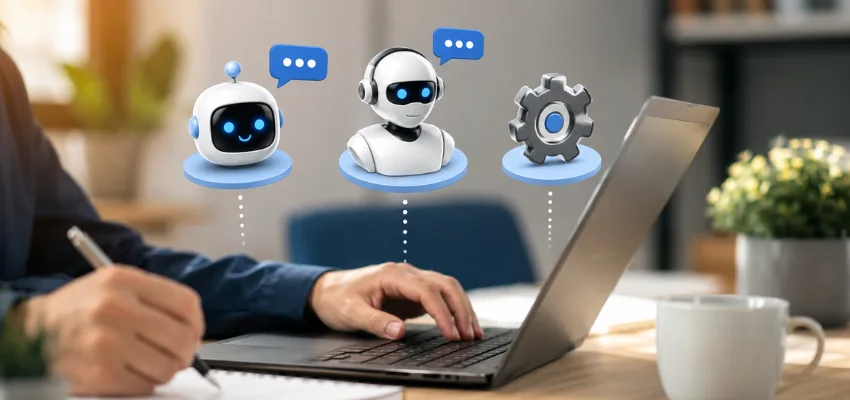
Think of it like this:
- Automation is like a vending machine. You press a button, it gives you exactly what you asked for, every single time, with zero thinking involved.
- Chatbots are like a shop assistant reading answers from a script. They can help with common questions, but if you ask something outside that script, they get confused fast.
- AI agents are like hiring a smart new employee. You give them a goal, and they figure out the steps, use different tools, make small decisions, and get the job done without you explaining every single move.
Same family, but very different levels of independence. This difference is exactly why the term agentic AI has become one of the hottest search terms in tech right now.
What automation actually means
Automation is the oldest of the three, and it is still incredibly useful today. It works by following fixed rules. If this happens, then do that. No thinking, no guessing, no interpretation.
For example, "if a customer fills a form, send them a confirmation email" is a simple rule. That is automation. It is dependable and consistent, and it never gets tired or bored. The catch is that it cannot handle anything unexpected. If the form has a mistake, or the customer wants to ask a follow-up question, automation simply stops. It does not know what to do next because nobody told it.
Here are some common uses of business automation:
- Sending invoices and payment reminders automatically
- Updating spreadsheets with new data
- Scheduling meetings based on fixed availability
- Sorting emails into folders based on keywords
It is the reliable, no-nonsense workhorse behind most workflow automation systems, quietly doing the boring stuff so humans do not have to.
What chatbots actually do
Chatbots came next, adding a layer of conversation on top of basic rules. Most chatbots are built to answer specific, common questions using pre-written replies or simple decision trees, almost like a flowchart you are chatting with. Some newer chatbots use AI language models to sound more natural and human, but at their core, most are still reactive. You ask something, they reply with whatever they were trained to say.
Chatbots are great for:
- Answering frequently asked questions on a website
- Helping customers reset a password
- Collecting basic information from a new lead
- Guiding someone through a simple, step-by-step process
The problem is that chatbots do not really think for themselves. If a customer asks something outside their training, the chatbot either gives a vague, unhelpful answer or hands the conversation over to a real human. They respond, but they do not plan or act on their own.
What AI agents actually do (and why everyone is talking about them)
Now here is where things get genuinely interesting, and why agentic AI is suddenly everywhere in tech conversations and search trends.
An AI agent does not just answer a question and stop there. It understands a goal, breaks that goal down into smaller steps, uses different tools or software along the way, and even adjusts its plan if something unexpected happens. It is less like a script stuck on repeat, and more like a digital assistant that actually has some initiative.
For example, imagine a customer asks, "Where is my order?" A basic chatbot would simply say, "Please check your tracking link." An AI agent, on the other hand, could actually log into the order system, check the real status, notice the order is delayed, automatically apply a refund if company policy allows it, and then send the customer a clear, honest explanation. All of that, without a human clicking a single button.
This is the real difference between AI agents and automation. Automation always follows the exact same fixed path. AI agents can adapt, reason a little, and make small decisions on their own, all within limits that you, the business owner, set for them. This is exactly why so many companies are now exploring intelligent automation and AI-powered workflows to handle work that used to need constant human attention.
AI agents vs chatbots vs automation: the simple comparison
| Feature | Automation | Chatbot | AI agent |
|---|---|---|---|
| Follows fixed rules | Yes | Mostly | Sometimes, but can adapt |
| Understands natural conversation | No | Yes | Yes |
| Makes independent decisions | No | No | Yes |
| Uses multiple tools or systems together | Rarely | Rarely | Often |
| Learns and adjusts mid-task | No | No | Yes, within limits |
| Best suited for | Repetitive, predictable tasks | Answering simple, common questions | Complex, multi-step tasks needing judgment |
So what does your business actually need?
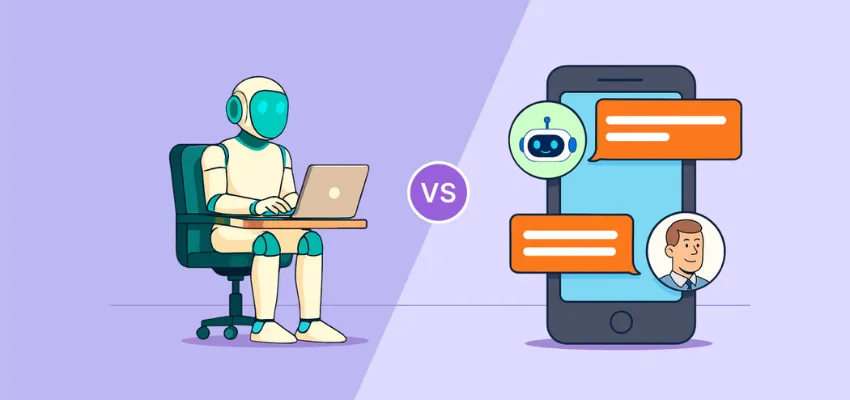
Here is the honest answer: it depends on your actual problem, not on whatever sounds trendiest in a sales pitch this week.
- If you have repetitive, predictable tasks, like sending emails, updating records, or generating weekly reports, plain automation is often more than enough. There is no need to overcomplicate a simple job.
- If your customers keep asking the same handful of questions again and again, a chatbot can save your support team a huge amount of time and repeated effort.
- If you have processes involving multiple steps, decisions, and different tools working together, like handling customer complaints from start to finish or screening job applications, an AI agent can genuinely save hours of manual, tiring work.
Many smart businesses actually end up using all three together, almost like a team with different roles:
- Automation quietly handles the boring, repetitive background tasks
- Chatbots manage simple, front-facing customer questions
- AI agents take on the bigger, judgment-based tasks that used to require a human sitting and thinking it through step by step
The bottom line
AI agents, chatbots, and automation are not rivals fighting for the same job. They are simply tools with different levels of intelligence and independence, and understanding that difference is the first real step toward using them well. The smartest businesses are not the ones chasing the newest buzzword every quarter. They are the ones matching the right tool to the right problem, at the right time.
So before you spend money on the shiniest new AI agent solution on the market, ask yourself one simple question: do I actually need something that thinks and decides on its own, or would a good old reliable automation rule do the exact same job, faster and cheaper?
Sometimes the vending machine is exactly what you need. Sometimes you genuinely need the smart new employee. Knowing the difference between the two is what actually saves your business real time and real money.
Sustaining business growth requires moving away from scattered tools, messy spreadsheets, and informal tracking. Platforms like Neome leverage automated streamlining to handle complex business operations in a single, cohesive workspace. It replaces fragmented data with a unified source of truth, helping scaling companies automate routine processes, eliminate communication gaps, and maintain organisational velocity as the team expands.
FAQs
- What is the main difference between AI agents and chatbots? Chatbots mainly answer questions using scripts, while AI agents can plan steps and complete full tasks on their own.
- Is automation the same as artificial intelligence? No, automation just follows fixed rules, while AI can understand context and make smarter decisions.
- Can a chatbot be considered an AI agent? Usually not, since most chatbots only reply to messages and do not take real actions across different systems.
- Which one should a small business start with first? Start with automation for simple repetitive tasks, then add chatbots or AI agents as your needs grow bigger.
- Why is everyone suddenly talking about agentic AI? Because agentic AI can handle multi-step business tasks on its own, saving a lot of time that used to need constant human effort.
Keep reading
More from the Neome blog.

How to run WhatsApp CRM without losing the next step
Deals do not die because WhatsApp is the wrong channel. They die when nobody owns the lead, stages are unclear, and the next step has no date. Here is how operators keep conversation and pipeline together.
Read article →
Real-time business visibility: tools that show you what's happening right now (2026)
See how real-time business visibility tools help you track sales, stock, and deliveries live in 2026, so you can catch problems fast and act sooner.
Read article →Curious how this works in practice?
Watch real teams of every size run on Neome, from solo operators to large enterprises.