How to run WhatsApp CRM without losing the next step
Deals do not die because WhatsApp is the wrong channel. They die when nobody owns the lead, stages are unclear, and the next step has no date. Here is how operators keep conversation and pipeline together.


Your sales team already lives on WhatsApp. A buyer asks for a price. Someone drops a product photo. A quote leaves as a screenshot. By Friday the thread still feels warm, yet nobody can say who owns the deal, which stage it is in, or when the next call is supposed to happen.
That is the real gap behind WhatsApp CRM for teams that sell in chat. The conversations are already there. What fails is the operating layer around them: a named owner, a stage the team agrees on, and a next step with a date. Without those three, deals go quiet while everyone assumes someone else is following up.
This piece is for operators who want to keep WhatsApp as the place buyers and reps talk, and still run a pipeline managers can trust. It is not about abandoning chat for a forms-first system the field will ignore. It is about making the chat trail sit beside a deal that someone owns.
Deals die quietly when chat is the only record
WhatsApp is excellent at speed. It is a weak system of record. When the thread is the only place a deal lives, the failure modes show up in familiar ways.
A warm lead lands in a personal chat or a busy group. Three people see it. Nobody claims it. A follow-up promise sits in someone's head. A revised quote goes out Tuesday. By Thursday the buyer has gone cold, and the only evidence is a scroll of messages mixed with good mornings and delivery updates.
Managers feel this as fog. They open the group looking for stage health and find noise. Reps feel it as rework. They retype the same contact into Excel, a notebook, or another app after every handoff. Buyers feel it as delay. They asked a clear question and waited longer than they should have.
None of that is mainly a selling skill problem. It is an ownership and dating problem. The conversation happened. The commitment did not get a home.
Teams that scale past founder memory hit this harder. When the company still runs like a small circle inside a larger headcount, informal chat stops being enough. The same pattern shows up when a business starts to feel chaotic around growth milestones: information fragments across people, and partial truths replace a shared picture of the pipeline.
The minimum that turns a chat into a deal
If you keep only three fields honest, most of the chaos drops.
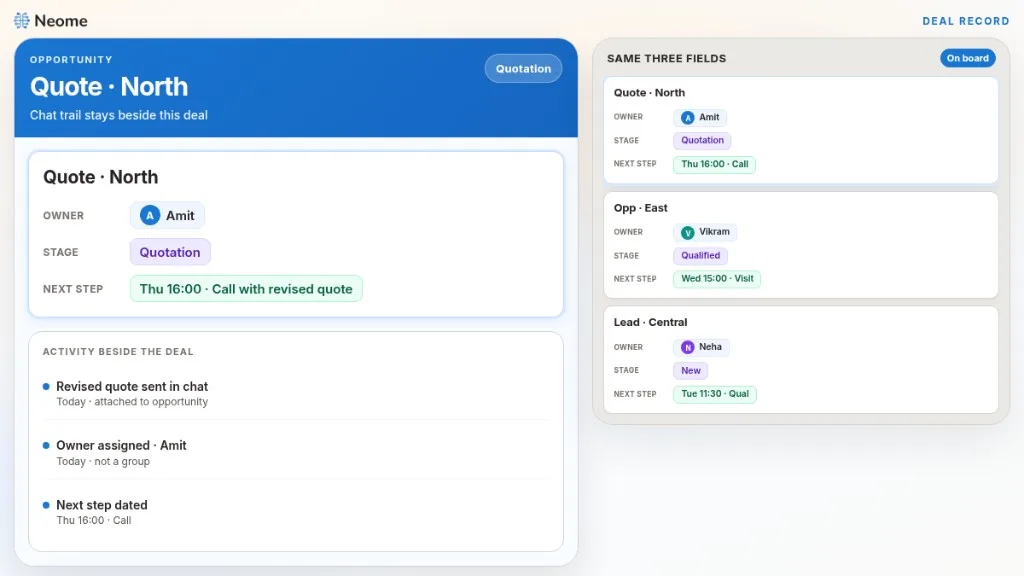
Owner. Every live lead or opportunity has one named person. Not a group. Not "sales." A person who knows the next move is theirs.
Stage. The team uses a short set of stages it actually works, such as new, qualified, quotation, negotiation, won, lost. Stages are not decoration. They answer "where is this right now?" without opening a thread.
Dated next step. Every open deal has a next action with a calendar date (and ideally a time). "Follow up soon" is not a next step. "Call Rohit Thursday 4 pm with the revised quote" is.
Those three turn WhatsApp from a memory dump into an input surface. The chat can stay rich and human. The deal record carries the commitment.
Add a fourth habit when you can: keep the activity trail beside the deal so field and office do not rebuild context from screenshots. A quote sent, a site visit logged, a price change agreed in chat, each of those should be findable from the opportunity, not only from someone's phone.
If a vendor cannot show you owner, stage, and dated next step on one screen, you are not shopping for pipeline. You are shopping for another inbox.
A practical test helps. Take last week's hottest thread. Ask the room: who owns it, what stage is it in, and what is the dated next step? If three people give three answers, the chat is doing conversation work and nobody is doing CRM work. Fix that before you buy another dashboard.
What a healthy Monday morning looks like
Picture a sales lead opening the week without scrolling three groups first.
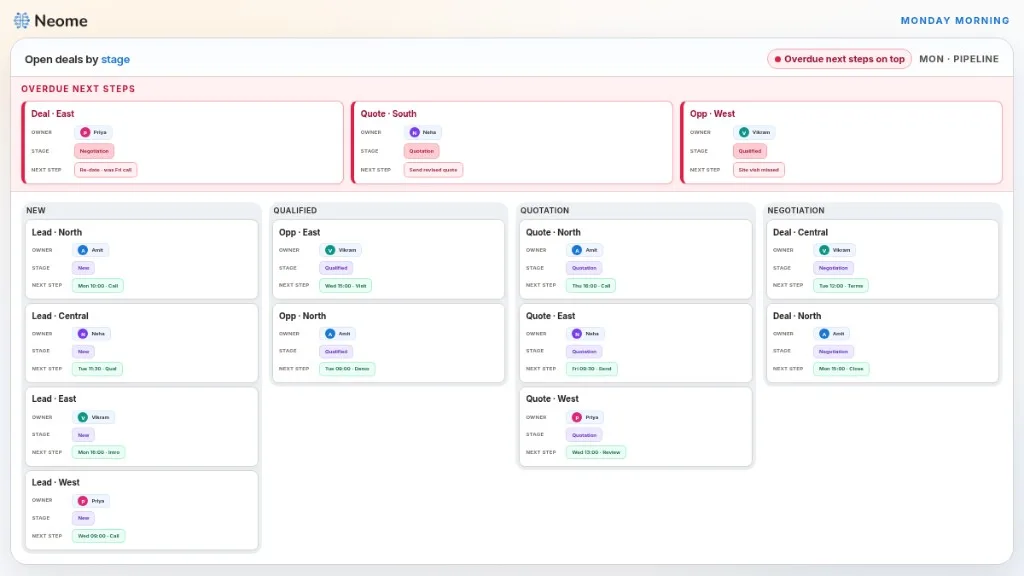
They see open deals by stage and value. Each card shows an owner. Overdue next steps sit at the top, not buried under stickers. A lead that came in over the weekend already has an assignee and a follow-up raised as a task. Nobody asks in the group "who is taking this?" because assignment already happened.
Field reps start the day from the same record. They know which visits and calls are due. They can update the deal from the phone without exporting anything. Office staff see the same stages, so a quotation request does not vanish into a private chat.
That Monday is not about more messages. It is about fewer mysteries. The chat still happens. The CRM question is answered before lunch: what is open, who owns it, and what is due today.
You will still have busy weeks. A buyer will still ping after hours. A rep will still send a photo from a shop floor. The difference is that those moments stop being the only copy of the truth. When someone is on leave, the deal does not leave with their phone. When a manager joins a call, they do not need a five-minute recap pieced together from forwards.
How Neome keeps the chat trail on the deal
Neome CRM is built for teams that already work from WhatsApp, chat, Excel, and web. The path is meant to feel continuous rather than like a handoff between tools.
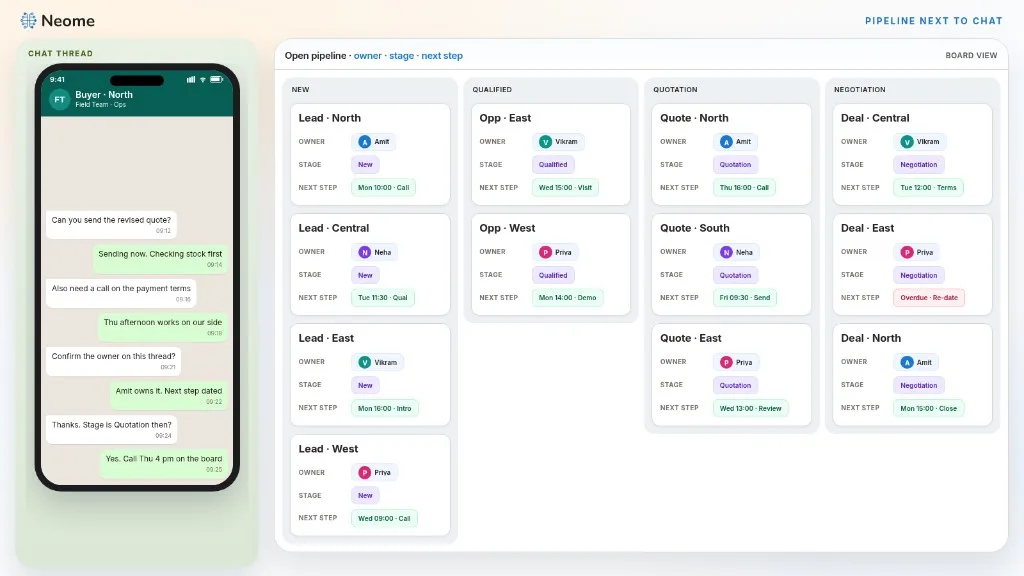
A lead is captured and assigned. The owner gets the assignment where they already work. A dated next step is raised as a task and chased. When the lead is ready, convert creates account, contact, and opportunity together so nobody retypes the same company three times. Deals sit on a pipeline board with value and owner on each card. Lead and performance dashboards give managers stage health without pinging a group for updates.
Team chat can live beside the deal, with @mentions, so the discussion stays attached to the record instead of floating in a general channel. Lead management covers the intake and ownership layer. WhatsApp Inquiry Management helps sync the groups and chats you choose so genuine enquiries can feed the same queue, rather than dying as unread screenshots.
CRM sits among 25+ modules on the same per-user Standard price. There is no separate fee to "turn CRM on." Standard starts with a 15-day trial. Enterprise is the path when you need custom workflows, integrations, and an SLA scoped before go-live. Neome is built for teams from about 10 to 10,000. The product does not change with company size. How you start does.
In other words, a working WhatsApp CRM here means the buyer still chats the way they always did, while the team finally shares one deal record. The chat is the conversation. The pipeline is the commitment. Both stay visible.
Proof from teams that already left informal chaos
We do not invent conversion rates for chat-to-pipeline. What we can show is how published customers moved field and sales work off informal trails and onto one platform.
Maniarr's Khakhra described WhatsApp messages, spreadsheets, and unstructured calls creating operational chaos before they digitized attendance, beat planning, visit logging, orders, and inventory. Their learning was familiar: a WhatsApp-like interface lowered the adoption cliff, while structured workflows gave management a real view of field activity.
260 Brands moved attendance, beat plans, visits, orders, executive stock, and collections onto one platform with a chat-based interface and offline support for remote beats. The challenge was not that people refused to communicate. It was that phone calls, paper, and spreadsheets could not answer what happened on the beat that day.
Gallon Water connected order lifecycle, inventory, dispatch, and collections so follow-ups and stock no longer lived only in manual trails. HCD India connected rider onboarding, fleet, payments, and related ops on one system instead of scattered handoffs.
Read those pages for the full before-and-after. Use them as proof that chat-adjacent field and sales work can sit on one record. Do not treat them as borrowed WhatsApp-to-revenue percentages.
This is not the same problem as WhatsApp groups for field management
A related but different question shows up for field sales heads: how to manage the team when group chats bury visits, attendance, and beat updates. That is about leaving WhatsApp groups as the operating system for field force management.
If that is your pain, read How to manage a field sales team without WhatsApp groups. GPS check-ins, structured visit logs, and central task assignment solve a workforce visibility problem.
This post is about the commercial conversation that already happens in one-to-one and small threads: quotes, objections, follow-ups, and handoffs. You can fix field groups and still lose revenue if deals have no owner and no dated next step. You can also keep WhatsApp for buyer chat and still run a clean pipeline. The two fixes complement each other. They are not the same brief.
A simple split keeps the team clear. Use field tooling for where people are, which outlets they visited, and whether attendance and beats are real. Use CRM for who owns the revenue conversation, which stage the deal is in, and when the next commercial action is due. Mixing those jobs in one overflowing group is how both jobs get worse.
What to do this Monday
Pick ten open deals that currently live only in chat. For each one, write three lines in a shared place your team will actually open:
- Owner (one name)
- Stage (from your real short list)
- Next step with a date
Then run one week where no new lead enters a group without those three fields. Watch what happens to overdue follow-ups. Most teams discover they did not have a lead problem. They had an undated promise problem.
If the experiment proves the point, put the same discipline into a CRM the field will use from the phone, with the chat trail beside the deal. Start on Standard with the 15-day free trial (no credit card). Choose Enterprise later only if integrations, custom workflows, and an SLA need scoping before go-live.
One more Monday habit worth keeping: end the day by clearing overdue next steps or re-dating them with a reason. Overdue without a note is how "active" pipelines quietly become fiction. A short end-of-day pass beats a long weekend of pretending every open deal is still alive.
FAQs
- Is WhatsApp enough if we are disciplined about follow-ups? Discipline helps for a week. It rarely survives leave, handoffs, and growth. Owner, stage, and dated next step need a shared record, not only good intentions in a thread.
- Do we have to stop using WhatsApp with customers? No. Keep WhatsApp as the conversation surface. Move ownership, stage, and next steps onto a deal record so managers and teammates are not reconstructing the story from screenshots.
- How is this different from buying another traditional CRM? Many CRMs assume the team will live in forms and email. Teams that already sell on WhatsApp often abandon those systems within months. The fit question is whether the product keeps chat beside the pipeline, or asks the field to change habits first.
- Standard trial or Enterprise demo? Standard with a 15-day trial fits teams that can learn from the product in days. Enterprise fits when custom workflows, integrations, and an SLA must be scoped before go-live. Same CRM either way. Different start path.
Start the Standard 15-day trial: See Neome pricing and begin free
Ashish Patel is Business Head, Sales at Neome, working on sales pipeline and CRM for teams that sell in chat.
Keep reading
More from the Neome blog.

Real-time business visibility: tools that show you what's happening right now (2026)
See how real-time business visibility tools help you track sales, stock, and deliveries live in 2026, so you can catch problems fast and act sooner.
Read article →
Can AI really run my business operations? What it can (and can't) do in 2026
Wondering if AI can run your business in 2026? Learn what AI tools can and cannot do, and why human judgment still matters most.
Read article →Curious how this works in practice?
Watch real teams of every size run on Neome, from solo operators to large enterprises.